Real-world skills for real-world jobs
PROJECT OVERVIEW
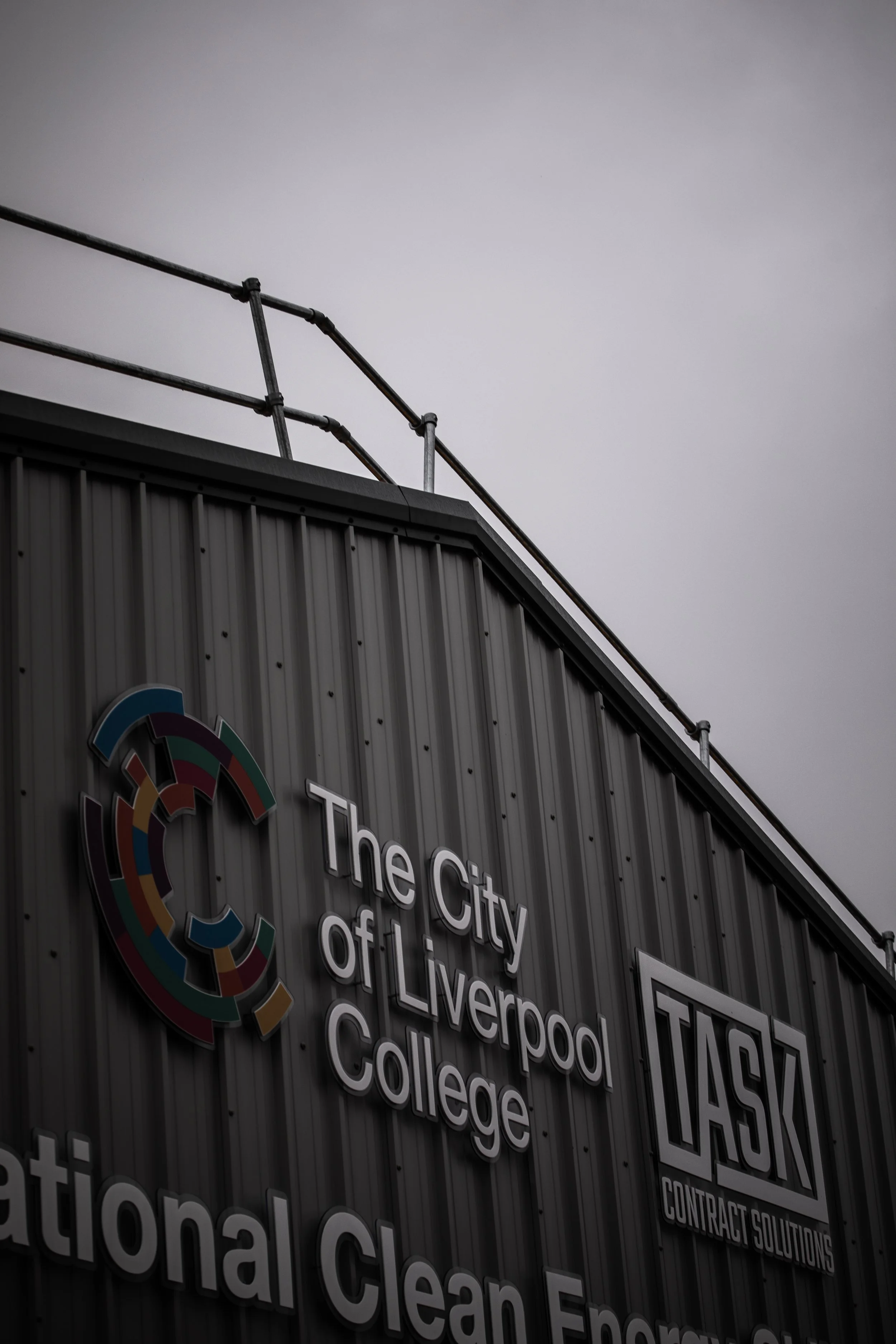
Client: The City of Liverpool College
Location: Liverpool Waterfront
The centre's curriculum focus is deliberately practical. Learners will be taught to design, install, maintain, monitor and commission energy-resilient projects across the residential, industrial and commercial sectors, from a domestic solar and battery installation to an integrated site-wide system with generation, storage, heating, EV charging and central control. Because the building is itself a live installation, learners will be able to see the consequences of design and commissioning decisions in real performance data rather than on a whiteboard.
That approach answers a national need. The Government's Clean Energy Jobs Plan, published in October 2025, sets out an ambition to double clean energy employment to around 860,000 jobs by 2030, an increase of some 400,000, with the Northwest alone expected to see up to 25,000 additional direct jobs. The plan identifies 31 priority occupations, led by electricians, plumbers, welders and engineers, and notes that entry-level roles in clean energy pay around 23 per cent more than the same trades elsewhere.
Those are precisely the trades this centre exists to develop.
Working together
TASK and the College are working with local, regional and international businesses to connect training to employment through work placements, apprenticeships and direct recruitment. TASK itself has been an active employer of apprentices and a partner in the College's certification of the personnel who build, install and maintain its systems, and it has now committed to training apprentices in renewable technologies at the centre for the next three years, giving the first cohorts a guaranteed route from the workshop floor into live projects. The centre allows that pipeline to be widened to the whole industry, so that a young person from Bootle, Kirkdale or Birkenhead can move from the workshop floor at Clarence Dock to a career installing and running the energy systems of the region.
What it means for the community
North Liverpool has one of the most important regeneration stories in the country unfolding around it: Liverpool Waters, the new stadium at Bramley-Moore Dock, the Mersey Heat network and the docklands renewal. Investment on that scale only benefits local people if they have the skills to take the jobs it creates. The centre puts a nationally designated clean-energy training facility within walking distance of some of the communities that stand to gain most, and it does so on a live construction and regeneration site where learners can see the industry at work around them.
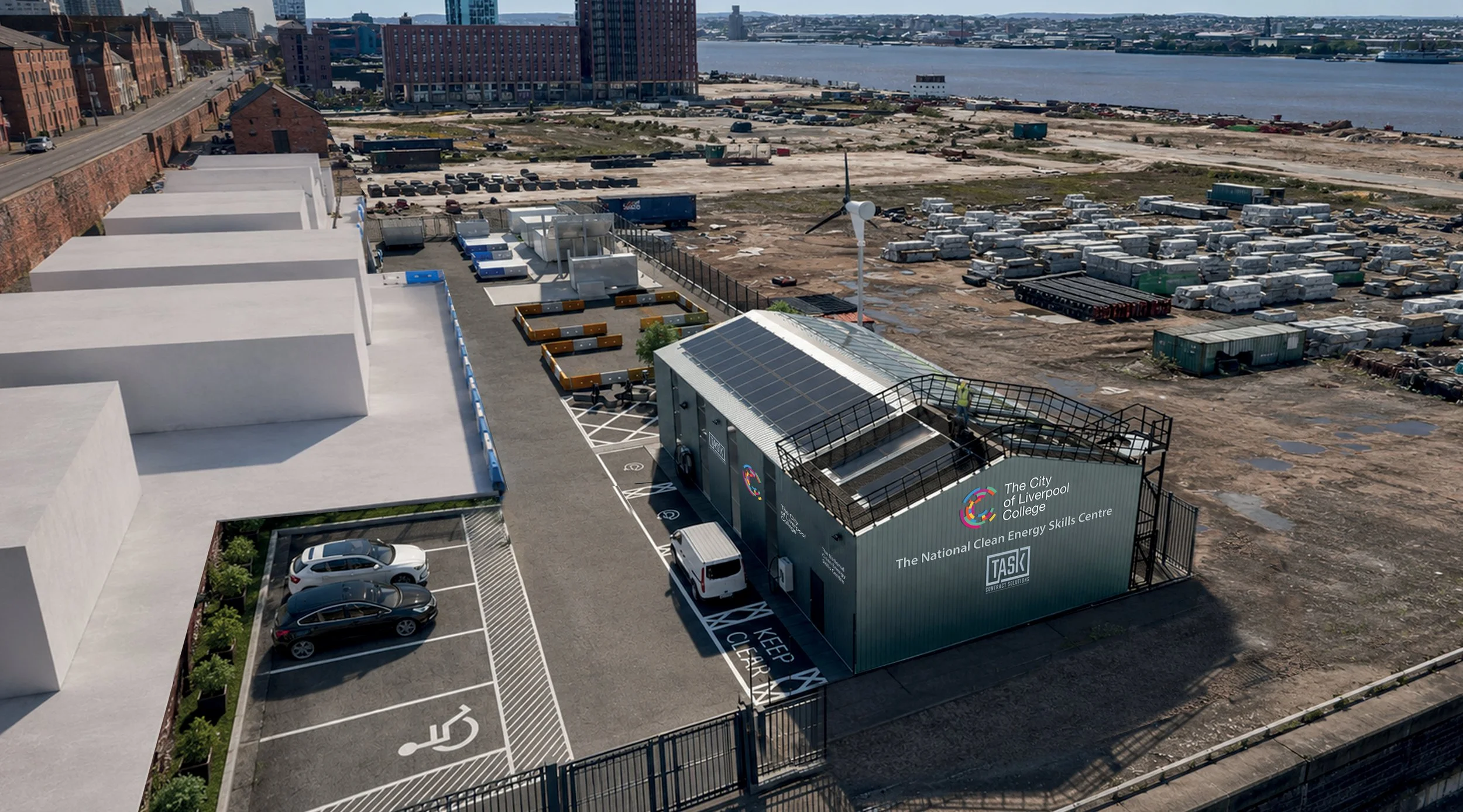
It also matters that the centre is visibly clean, resilient and modern. A wind turbine turning beside a solar-roofed workshop on the dock road is a daily, tangible statement that the energy transition is something Merseyside builds and operates, not something that happens elsewhere. For families weighing the value of a technical education, that visibility is part of the offer.
What it means for industry
Employers in the clean-energy supply chain consistently report that the shortage of competent installers, commissioning engineers and controls technicians is the single biggest brake on growth. The Technical Excellence College model addresses this by pairing employer-informed curriculum with facilities that match industry practice. For TASK and for its peers across the region, the centre creates a local source of trained, work-ready people who understand integrated systems, safety and standards from day one, reducing the cost and risk of bringing new starters into the workforce.
For TASK's own clients in the commercial, industrial, defence and government sectors, the partnership also strengthens the assurance behind the company's work. Systems delivered by TASK are installed and maintained by personnel trained and certified through an Ofsted-registered college, working to a curriculum built around the same technologies and control platforms that TASK deploys on site.
The United Kingdom has legislated to reach net zero by 2050 and has committed to a clean power system by 2030. The Liverpool City Region has set its own goal of becoming net zero carbon by 2040 and is advancing projects such as Mersey Tidal Power and the Mersey Heat network to get there. None of those targets can be met without a very large increase in the number of people able to design, install and operate distributed clean energy: solar, wind, storage, heat pumps, EV charging and the controls that bind them together into resilient systems.
That is the gap the National Clean Energy Skills Centre is built to close. Every learner who leaves Liverpool Waters is able to commission a battery system, fault-find a PV string or set up a SCADA platform is a direct contribution to the country's energy security and to its emissions targets. Energy resilience, the ability of a site or a community to keep running through disruption, is the other half of the same story, and it is at the heart of what TASK has learned from its defence work. By training the next generation in both, the centre serves the region's prosperity and the nation's security at the same time.
Contribution to energy security and net zero
A partnership TASK is proud of Established for over 23 years, TASK has built armouries, bunkers, secure server rooms and deep-level tunnel infrastructure for the Ministry of Defence and national telecoms operators and is a proud Gold Award holder under the Armed Forces Covenant Employer Recognition Scheme. That commitment to those who serve, and to the communities around defence estates, sits naturally alongside a centre built to open careers for young people.
Built on more than two decades of real projects
Few projects, however, carry the significance of this one. The National Clean Energy Skills Centre is a building the company has constructed for the people who will carry its industry forward: people of our future, working with the engineering technology of the future, for the future energy security of our country.
TASK thanks The City of Liverpool College, the Liverpool City Region Combined Authority, and specifically Colin Salmon and Elaine Bowker from Liverpool Waters for their part in delivering it and looks forward to welcoming the first learners through its doors.
CASE STUDIES
-
![]()
CLC: Energy Resilience Hub
TASK Contract Solutions has officially broken ground on a new £1m purpose-built Clean Energy Technical Excellence Centre for The City of Liverpool College at its Construction Academy at Liverpool Waters.
-
![SUNBELT RENTALS, LIVERPOOL]()
SUNBELT RENTALS, LIVERPOOL
Decarbonisation Of Depot.
-
![OPENREACH, MANCHESTER]()
OPENREACH, MANCHESTER
Tunnel Lighting Replacement.
-
![HMS EAGLET, LIVERPOOL]()
HMS EAGLET, LIVERPOOL
EV Chargers.
-
![MOD, WORKINGTON]()
MOD, WORKINGTON
Eco-friendly Military Facilities.
-
![P&G, MANCHESTER]()
P&G, MANCHESTER
High-strength Epoxy Resin Surfacing.
-
![GOLDBECK, REYDON]()
GOLDBECK, REYDON
Renewable Energy System.
-
![RAF, ASHTON UNDER LYNE]()
RAF, ASHTON UNDER LYNE
Stabilising The Air Cadet Corps Training Unit.
-
![ROYAL NAVY]()
ROYAL NAVY
Preserving Maritime History.
-
![MILITARY CAMP, NORTH LIVERPOOL]()
MILITARY CAMP, NORTH LIVERPOOL
Mezzanine Floor Installation.
-
![SUNBELT RENTALS, MILTON KEYNES]()
SUNBELT RENTALS, MILTON KEYNES
Electricty Upgrade.
-
![HMS EAGLET, LIVERPOOL]()
HMS EAGLET, LIVERPOOL
Green Energy And Sustainability.
-
![OPENREACH, LONDON]()
OPENREACH, LONDON
Power Distribution Boxes.
-
![MOD, MERSEYSIDE]()
MOD, MERSEYSIDE
Advanced EV Charging.
-
![GOLDBECK, YORKSHIRE]()
GOLDBECK, YORKSHIRE
Renewable Energy System.
-
![DRES]()
DRES
Deployable Resilient Energy Systems (DRES).
-
![MOD ARMOURIES]()
MOD ARMOURIES
Enhancing Safety And Security.
-
![SUNBELT RENTALS, POMEROY ST]()
SUNBELT RENTALS, POMEROY ST
Renewable Energy Integration.
-
![MOD, MERSEYSIDE]()
MOD, MERSEYSIDE
Efficient Shelter Solution.
-
![MOD, BARROW IN FURNESS]()
MOD, BARROW IN FURNESS
Decarbonisation Strategy.