People of our future, engineering of the future

PROJECT OVERVIEW
Client: The City of Liverpool College
Location: Liverpool Waterfront
On the edge of Clarence Dock at Liverpool Waters, in the shadow of the new Hill Dickinson Stadium, a compact green-clad building with a wind turbine at its gate and a solar array across its roof now marks the start of something new for Merseyside.
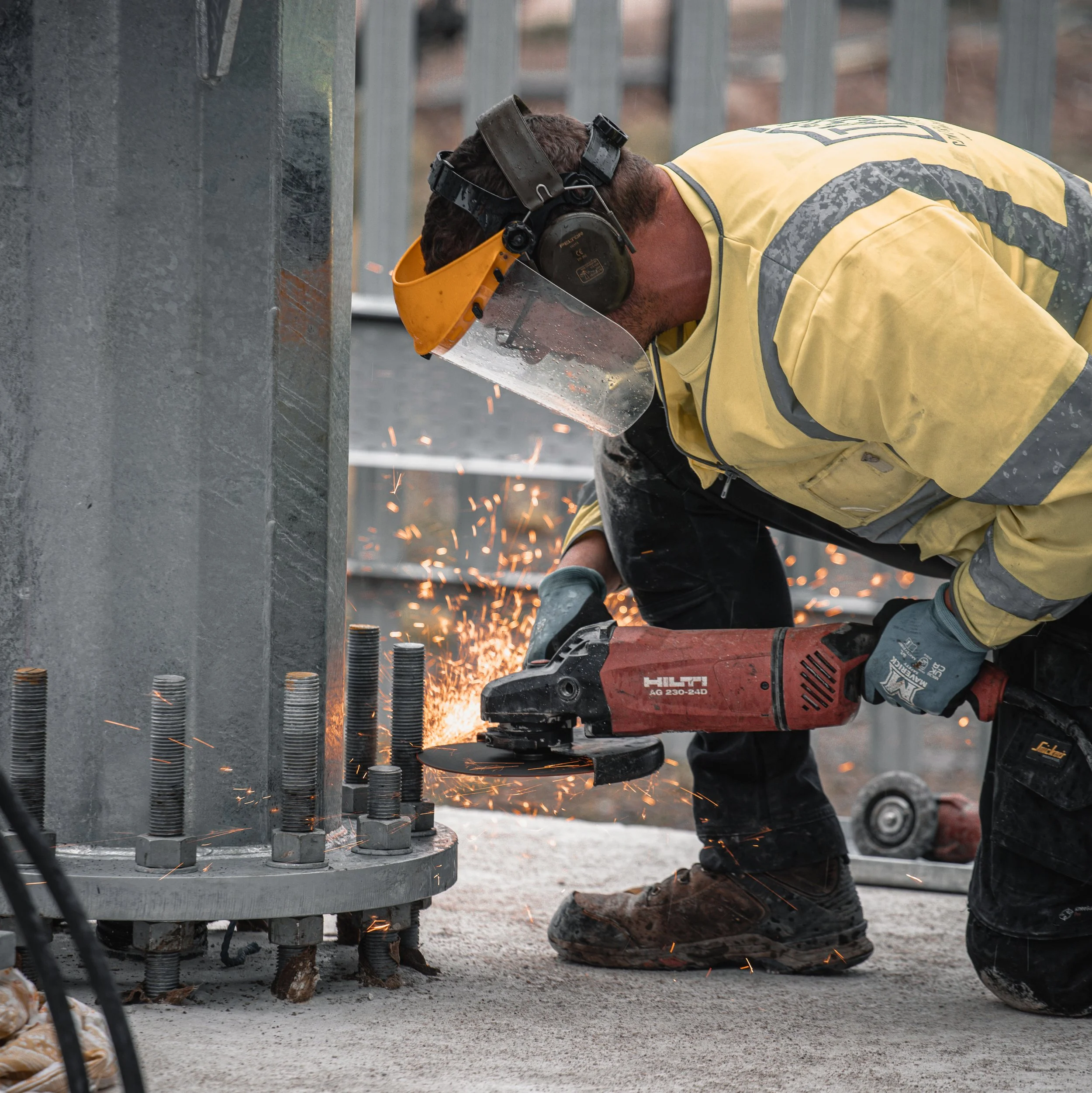
The National Clean Energy Skills Centre: the first purpose-built facility of its kind in the UK, created by The City of Liverpool College and constructed by Task Contract Solutions Ltd (TASK). Its purpose is simple to state and hard to deliver. It exists to give young people and career-changers from Liverpool, the wider city region and beyond, the real-world skills to design, install, maintain, monitor and commission the energy-resilient systems that residential, commercial, industrial and the country will depend on for decades to come.
A national designation, delivered locally
TASK is proud to have worked alongside the College to bring the centre from concept to completion. This case study sets out what has been delivered, why it matters to the community, what it means for industry and employment, and how it connects to the United Kingdom's clean power and net zero commitments.

Supporting skills across the Liverpool City Region
In April 2026 the Department for Education named The City of Liverpool College one of five Clean Energy Technical Excellence Colleges in England, sharing in a £175 million programme funded jointly by the Department for Education, the Ministry of Defence and the Department for Business and Trade. The College was selected on the strength of its achievement rates, a curriculum aligned to national and regional clean energy priorities, and its employer partnerships. As the North West hub it works with The Manchester College, Cheshire College South and West, and Blackpool and The Fylde College, sharing specialist training, facilities and expertise across the region.
The centre at Liverpool Waters is the physical expression of that designation. Capital funding of around £1 million from the Technical Excellence programme has created a dedicated, industry-compliant training facility rather than a classroom with a demonstration rig in the corner. Ground was broken in August 2026 and the building was programmed to open for the start of the new academic year in September 2026. The College's construction academy welcomed around 250 students in its first year; with the new centre it expects to double that number.
This development will see world-leading technology for Liverpool, delivering for the careers of today, tomorrow and beyond.
Elaine Bowker, Principal and Chief Executive, The City of Liverpool College
What TASK has delivered
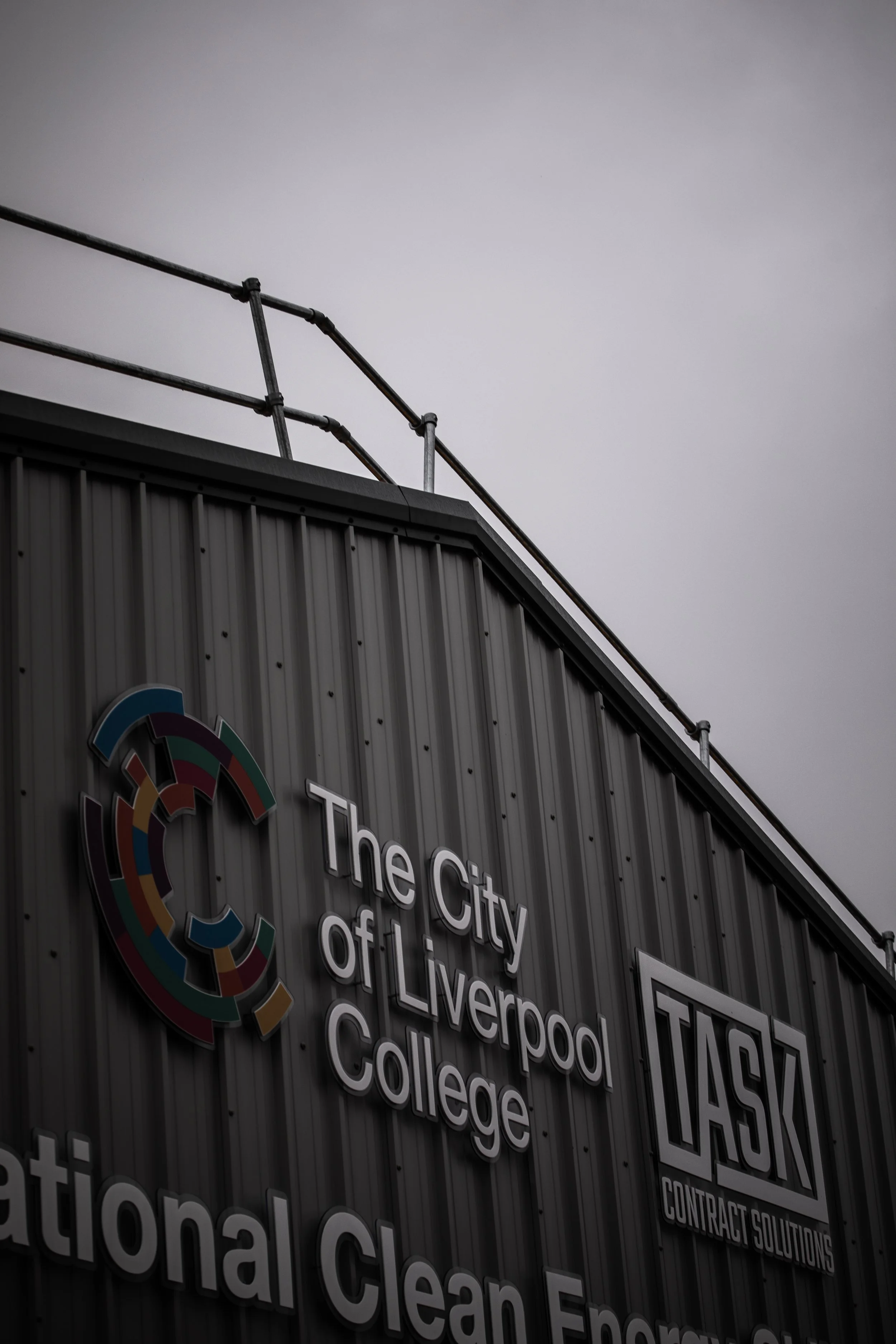
TASK designed and constructed the centre as a complete, working clean-energy installation, so that every technology a learner will meet in the field is present on site, generating, storing and controlling real energy. The building itself is a compact steel-framed hub, a rooftop solar photovoltaic array with a safe-access training gantry, a free-standing wind turbine at the site boundary, AC and DC electric vehicle charge points in the forecourt, and a secure fenced compound with outdoor workspace for apprentices. The exterior carries the identities of both the College and TASK, reflecting a partnership rather than a simple contractor relationship.
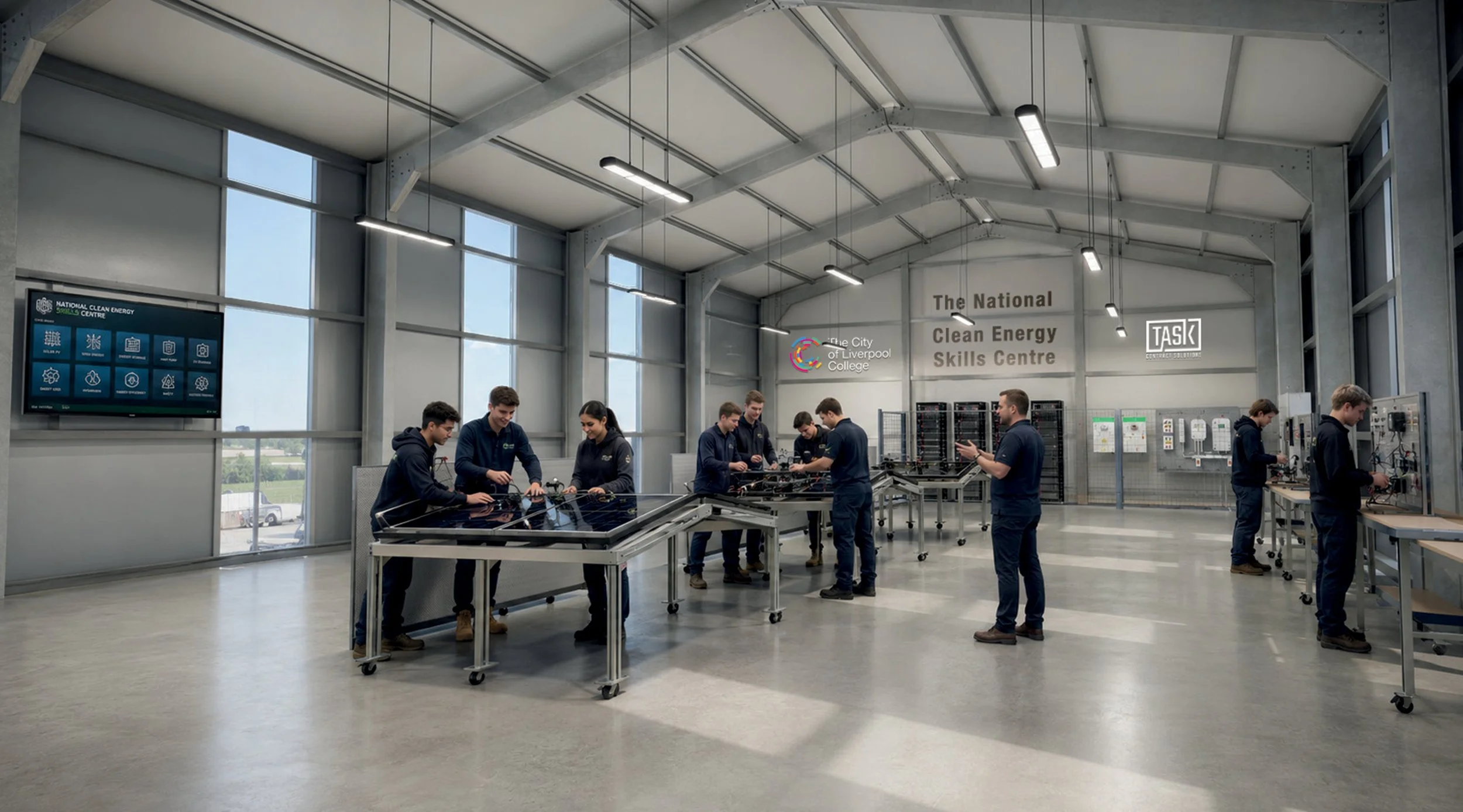
Inside, the workshop floor is laid out as a series of practical training bays. Mobile solar module benches allows apprentices to build, wire, test and fault-find Solar PV strings at working height. Battery energy storage cabinets are installed as they would be on a commercial site.
Wall-mounted AC and DC EV chargers can be designed, commissioned, monitored and serviced. Heat-pump, hot-water and heating-distribution equipment brings the building-services side of decarbonisation into the same room as the generation side. A large control display at the end of the hub shows the live energy-management platform, so that monitoring and commissioning are taught as skills in their own right, not as an afterthought.
The result
In the words of TASK's Managing Director, is a "full picture":
Design, installation, maintenance, monitoring and commissioning brought together in one purpose-built facility that meets the standards of the industry it serves.
This development is a full picture, with design, installation and maintenance all in one purpose-built, industry-compliant facility.
Ian MacVicar, Managing Director, Task Contract Solutions Ltd
Built on more than two decades of real projects
The centre is not a showpiece designed from a catalogue. It draws directly on the systems TASK has been delivering for its clients over more than 23 years in business.
TASK has installed solar since 2014 and has delivered decarbonisation projects since 2017, on sites ranging from commercial premises to ancient monuments. That work has since evolved into a broader energy security and resilience offering, built around state-of-the-art controls, for commercial, industrial, government and Ministry of Defence clients. Across that portfolio TASK has delivered solar photovoltaic arrays, wind turbines, AC and DC electric vehicle chargers, SCADA control platforms, air-to-air and air-source heat systems for space heating, hot water and air source to existing radiators within commercial sites, advanced lighting, and battery energy storage systems, integrated so that a site can keep operating cleanly and securely whatever is happening on the grid.
Much of that experience has been earned on defence estates, where reliability is not negotiable. TASK's self-funded Deployable Resilient Energy System (DRES) at Altcar Training Camp on Merseyside has run as a live, continuously monitored solar, wind and battery installation for several years, including powering an off-grid 30kW DC electric vehicle charger. The same engineers, standards and control platforms that underpin those installations have shaped the layout and the equipment specification of the Liverpool Waters centre. Learners will be trained on the technologies TASK actually installs, to the standards TASK's clients actually demand.
CASE STUDIES
-
![]()
CLC: Energy Resilience Hub
TASK Contract Solutions has officially broken ground on a new £1m purpose-built Clean Energy Technical Excellence Centre for The City of Liverpool College at its Construction Academy at Liverpool Waters.
-
![SUNBELT RENTALS, LIVERPOOL]()
SUNBELT RENTALS, LIVERPOOL
Decarbonisation Of Depot.
-
![OPENREACH, MANCHESTER]()
OPENREACH, MANCHESTER
Tunnel Lighting Replacement.
-
![HMS EAGLET, LIVERPOOL]()
HMS EAGLET, LIVERPOOL
EV Chargers.
-
![MOD, WORKINGTON]()
MOD, WORKINGTON
Eco-friendly Military Facilities.
-
![P&G, MANCHESTER]()
P&G, MANCHESTER
High-strength Epoxy Resin Surfacing.
-
![GOLDBECK, REYDON]()
GOLDBECK, REYDON
Renewable Energy System.
-
![RAF, ASHTON UNDER LYNE]()
RAF, ASHTON UNDER LYNE
Stabilising The Air Cadet Corps Training Unit.
-
![ROYAL NAVY]()
ROYAL NAVY
Preserving Maritime History.
-
![MILITARY CAMP, NORTH LIVERPOOL]()
MILITARY CAMP, NORTH LIVERPOOL
Mezzanine Floor Installation.
-
![SUNBELT RENTALS, MILTON KEYNES]()
SUNBELT RENTALS, MILTON KEYNES
Electricty Upgrade.
-
![HMS EAGLET, LIVERPOOL]()
HMS EAGLET, LIVERPOOL
Green Energy And Sustainability.
-
![OPENREACH, LONDON]()
OPENREACH, LONDON
Power Distribution Boxes.
-
![MOD, MERSEYSIDE]()
MOD, MERSEYSIDE
Advanced EV Charging.
-
![GOLDBECK, YORKSHIRE]()
GOLDBECK, YORKSHIRE
Renewable Energy System.
-
![DRES]()
DRES
Deployable Resilient Energy Systems (DRES).
-
![MOD ARMOURIES]()
MOD ARMOURIES
Enhancing Safety And Security.
-
![SUNBELT RENTALS, POMEROY ST]()
SUNBELT RENTALS, POMEROY ST
Renewable Energy Integration.
-
![MOD, MERSEYSIDE]()
MOD, MERSEYSIDE
Efficient Shelter Solution.
-
![MOD, BARROW IN FURNESS]()
MOD, BARROW IN FURNESS
Decarbonisation Strategy.